I’ve been somewhat fascinated with composite images of faces, also called mean faces, where lots of images of a population are averaged, which can reveal easily observable differences between populations. I wanted to have a go at it myself, and decided to see if there would be clear differences between the faces of politicians on the left and right of the political spectrum. This is more of a fun experiment than rigorous statistical work, as I wanted to work with composite images. So I made composite faces of Danish politicians with images from the Danish parliament. I find that there are differences, but they are very minor.
To be clear, I do not believe the way someone looks necessarily determines their political orientation, nor do I believe that the political orientation of a person determines how they look (although both could have an influence, but that would be environmental more than genetic). I do however believe that there could be a genetic component, which could influence both. That is, some genes might have an influence on facial shape and simultaneously influence how someone views the world and thus influence the political orientation.
I fetched images from the websites of the Danish parliament. I excluded members with non-Northern European names to control for potential ancestry effects and removed greyscale images for consistency. Neither exclusion made much of an observable visual difference.
The composite images were created by using the OpenCV library to identify the 68 facial points in order to triangulate them using Delaunay triangulation. This allows for warping the triangle using an affine transformation on each individual image to the coordinates of the corresponding triangle in an output image, where each point is calculated as the average of the point in all the images.
I tried creating composites for each party, but the sample sizes were too low to get interesting results, so I went for a dichotomization and sorted the parties into right- and left-leaning parties. This was primarily done from a heuristic of which block they have mainly supported in the past couple of decades. Doing so I excluded Radikale Venstre (Danish Social Liberal Party), since they are famously center as well as new party Moderaterne, since where they stand is not entirely clear as of yet. The dichotomization turns out as such
| Left-leaning parties | Males | Females |
|---|---|---|
| Social Demokratiet (Social Democrats) | 61 | 34 |
| Socialistisk Folkeparti (Green Left) | 14 | 19 |
| Enhedslisten (Red–Green Alliance) | 16 | 11 |
| Alternativet (The Alternative) | 5 | 7 |
| Total | 96 | 71 |
| Right-leaning parties | Males | Females |
|---|---|---|
| Venstre (Left, Denmark’s Liberal Party) | 51 | 23 |
| Dansk Folkeparti (Danish People’s Party) | 22 | 16 |
| Liberal Alliance | 14 | 11 |
| Det Konservative Folkeparti (Conservative People’s Party) | 14 | 18 |
| Nye Borgerlige (New Right) | 4 | 1 |
| Danmarksdemokraterne (Denmark Democrats) | 7 | 7 |
| Total | 98 | 76 |
I also wanted to see if there were any noticeable differences in the faces of politicians who have held a position as minister and those who have not. Due to the much lower number of ministers, their composite images appear less blurry, making them harder to compare to composites from larger groups. To enable fairer comparison, I created four additional composites by randomly sampling the same number of non-ministers for each.
First, let’s see what the average face of a current Danish member of parliament looks like.
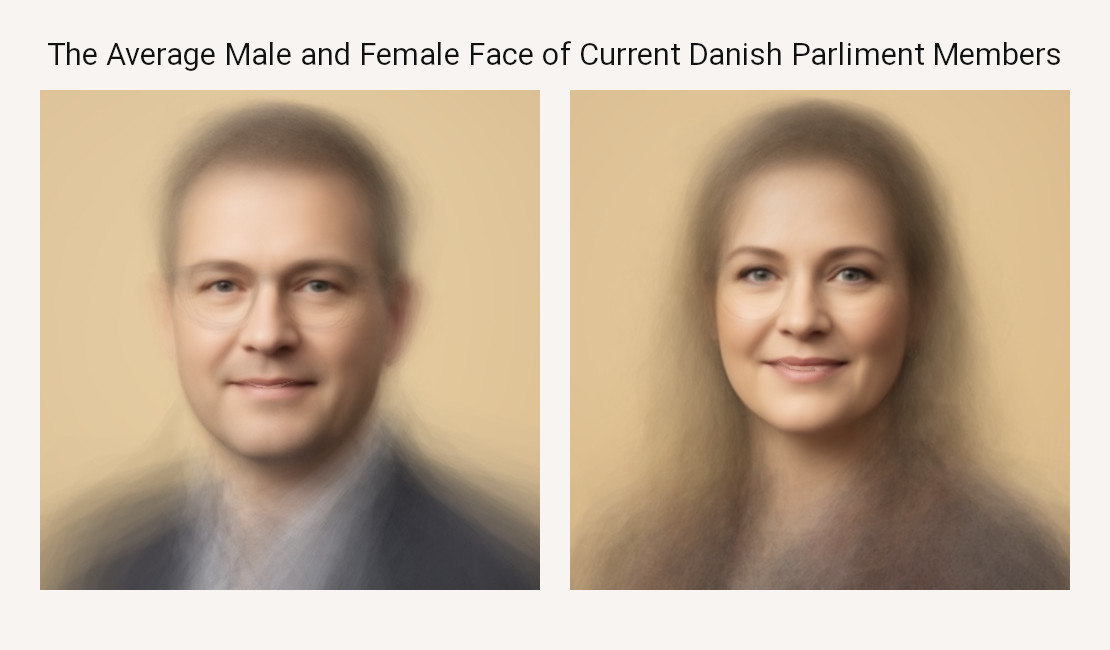
Let’s see what they look like when they are broken up by political leaning.

While the left- and right-leaning male faces are very similar, some slight differences emerge. The eyes of the male faces are very similar, but the facial shape appears to differ a tiny bit. The right-leaning face seems to have a slightly wider forehead as well as jaw line and a longer face overall.

For the female faces, the facial shape is very similar, but the eyes appear somewhat different and more so than for the males. First thing I notice is the difference in eye shape, where right-leaning females have their eyes slightly wider open. Even more noticeable is the difference in eye color. While both are blue, right-leaning politicians have a somewhat lighter shade of blue. The hair also seems to be a lighter blonde. The difference in hair color could of course be explained by bleaching, which is not uncommon among Scandinavian women. Even though they are often naturally blondish, many will bleach it further. It could simply be that women who lean right politically are more concerned with appearance, although the amount of eye makeup seems to be very similar between right and left, but probably a bit more pronounced among the right-leaning women. This could also possibly explain a difference in eye appearance, but it does not explain the difference in color. The frames of glasses are barely visible on the face of left-leaning females, which again could indicate that right-leaning women are more concerned with appearance and might be more likely to wear contacts. I was wondering if the glasses could cause a difference in eye color, since the color of blue eyes are very much dependent on the light that hits them, as they are in fact not actually blue, as they lack blue pigment. They are in reality grey, but due to how their structure changes the wavelength of the light hitting them, they appear blue. It could be that glasses change the way the light hits them, and cause them to appear a bit darker. I regenerated the composites excluding all images where the person was wearing glasses, but the difference persists.
The differences are easier to observe, when switching back and forth between the images. Clicking the below image will switch them.
For parliament members who have held office as a minister compared to those who have not, there are again differences. They are quite pronounced with males and not so much for females.

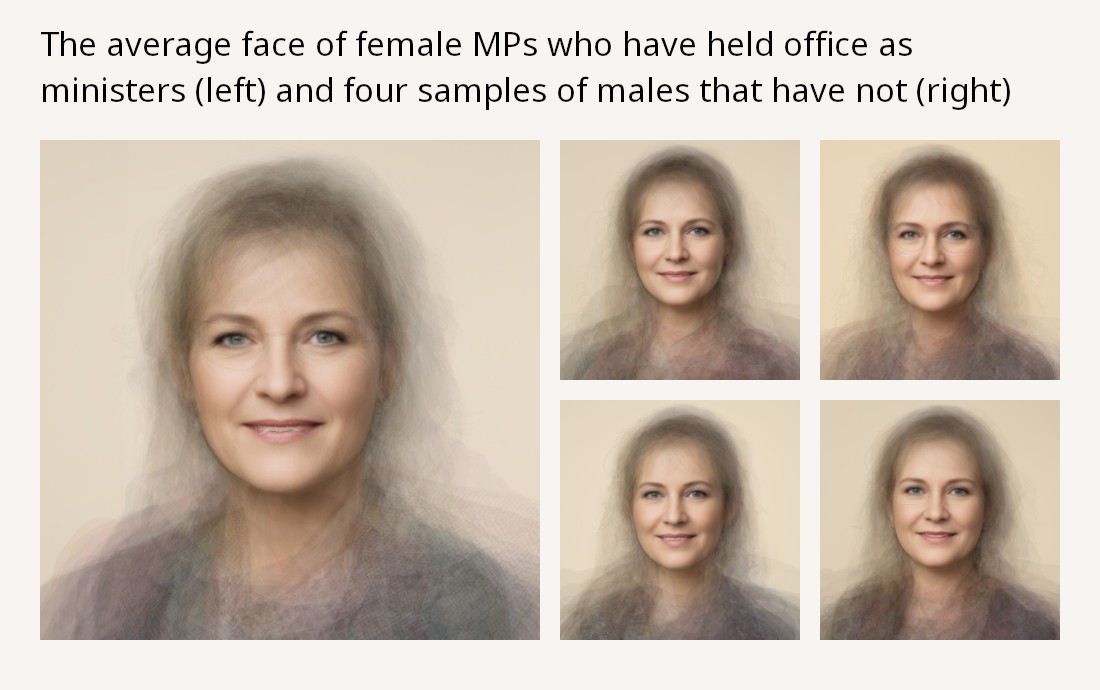
The differences are subtle but present. However, it’s hard to know how much lighting, camera lenses, settings, and editing might be influencing the results. Posture, especially for males, could potentially affect the slight differences observed between left- and right-leaning males, since right-leaning men tend to angle their torsos, while left-leaning men tend to face forward more directly. There was also no control for age and it appears that the male faces differ a bit in age, with right-leaning being older.
Furthermore the dichotomization could be considered an overly simplified representation of political leaning. Danish People’s Party for one, has generally been considered right-wing due to their views on immigration, but the rest of their key issues are quite close to those of the Social Democrats. A possible approach could be to use two dimensions, e.g., an economic and social, but that would in this case most likely result in groups with too few samples to get a meaningful average.
While subtle facial differences emerged between left and right-leaning politicians, and more pronounced differences between ministers and non-ministers, attributing these to any particular cause would be premature. The lack of controls for age, lighting, camera settings, and posture means the observed patterns could easily be artifacts rather than meaningful differences.